Posts

Reading Notes: PDE Mahabharata, Part D
Image
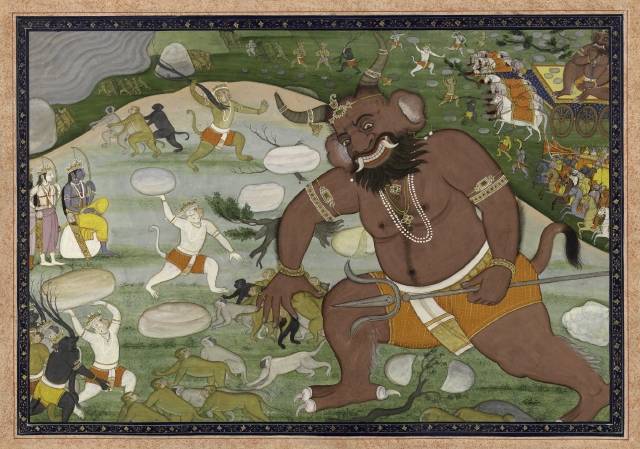
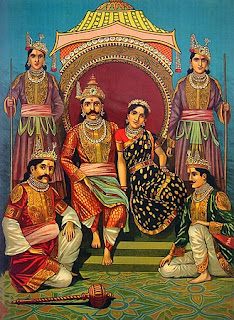
Taken from  The Mahabharata, A Summary   by John Mandeville Macfie. 61. Bhishma Falls Poor Bhishma. They got swept up in their emotion, but at the end of the day, death is death. And the death caused by members of your own family - what can be more cruel? I guess this is the fulfillment of Amba's threat/curse/promise? Because she blamed him for her not being able to marry anyone, at the beginning of the story. 64. Ghatotkhacha Another son dies. Who's next? 65. Death of Drona It's Drona, but only because the Pandavas tricked him into believing his son had been slain. Controversial! His son was the only reason he continued to hold on to life. The irony makes his death all the more sad. What will his son think? He doesn't even know his father is dead. We met Drona in the beginning of the story; he acted as a tutor and mentor to the Pandavas and the Kauravas, and now, he dies at their hands. Terrible. 67. Arjuna and Karna This is the supposedly the climax of t...
Reading Notes: PDE Mahabharata, Part C

Image
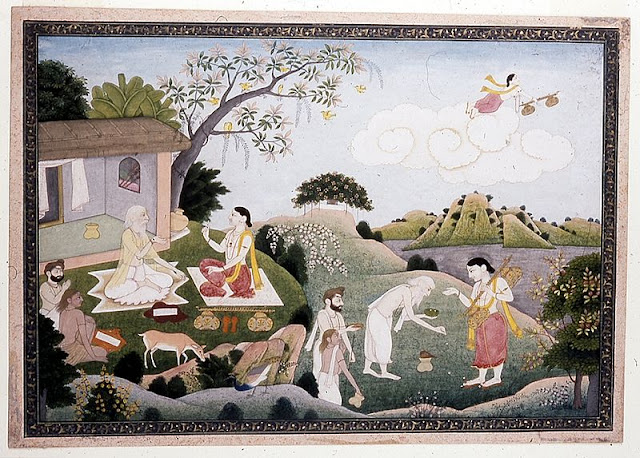
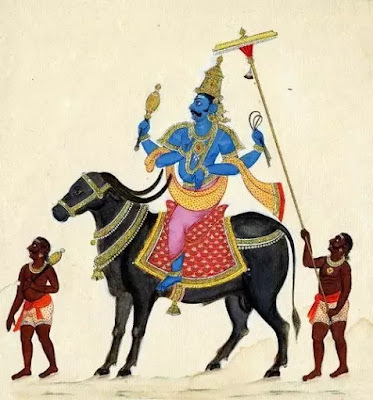
Taken from  The Mahabharata, A Summary   by John Mandeville Macfie. 42. Krishna's Visit A very interesting difference in attitudes from the Ramayana. In the Ramayana, Sita unquestioningly and loyally follows Rama, without a single complaint. Draupadi, on the other hand, is so moved with anger that she even questions the gods. Surprisingly, Bhima takes Draupadi's side, for Yudhishthira to take action and take back his kingdom, but Yudhishthira, as Rama did, is more prudent toward the keeping of his word than his position. The Mahabharata seems more...human than the Ramayana. I mean, yes, I get that Rama was the incarnation of Vishnu, so he's the "most righteous and upright, etc." but I feel as if the things he did/put up with were pretty unreasonable as a man. And the way he responded to them made him seem completely inhuman, which gives the reader nothing to connect to. In the Mahabharata, however, the reader can empathize with Draupadi, and have probably gon...

Week 6 Lab: Advice to Writers

Image
I was expecting a bunch of long, drawn out articles that highlight writing techniques, with analysis on "exemplary" writing throughout history, but was pleasantly surprised to see it's just a page full of quotes and snippets from various authors. Here are some I really liked: You Develop Empathy As a writer, it's important to approach your work through the lens of someone who's on the other end. This allows you to consider how you want to forge your story into one that the reader can appreciate. As you do this, you will develop this sense of empathy. You can relate to what your readers are feeling, whether that be boredom, interest, excitement, etc., and can adjust your narrative accordingly. A Character is Never a Whole Person   This title really caught my attention - is he saying that characters aren't really people? Nope, not at all. The writer, upon developing a character, must know every detail about him or her, but then must selectively show specif...

Reading Notes: PDE Mahabharata, Part A

Image
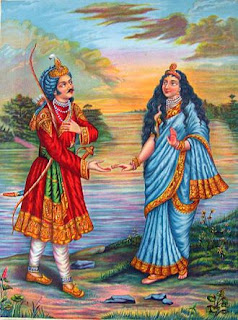
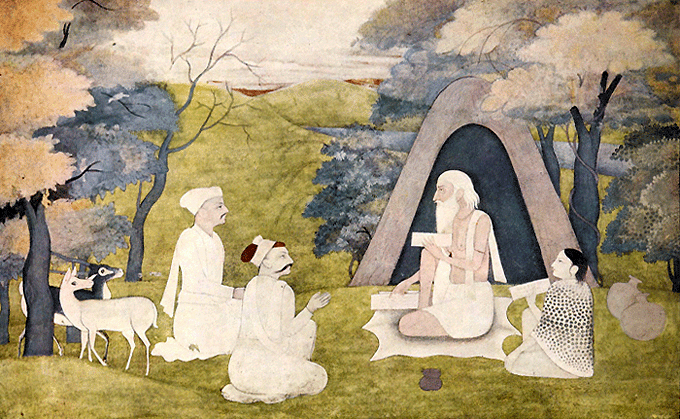
Taken from The Mahabharata, A Summary by John Mandeville Macfie. The illustrations for the Mahabharata are a lot more detailed than the ones for Ramayana. The Ramayana's were more flat and primitive, but the Mahabharata's have depth, shading, expressions, etc. that make it more interesting (in my opinion) to look at. Similar to how Valmiki was the author in the Ramayana (and also a character!), a guy named Vyasa is credited with writing the Mahabharata. From the wording though, it seems like he'll have a larger part to play than Valmiki did in his story. (King Shanatu and a beautiful woman on the Ganga, from Wikipedia ) King Shanatu and Ganga Aha! So this is where that story of Ganga throwing babies into the river comes from! And there's some justification behind it as well - the babies are actually celestial beings that have been cursed to have a human form. They went to Ganga to ask her to be their human mother, where she promised to throw them into the r...

Week 5 Story: Hakuro's Sons

Image
An updated version of this story can be found on my website, Rehashed Histories. ...a fuzzy haze... ...the bright faces of two young boys looking at him in excitement and awe... ...his own smiling face, full of pride, looking back at them... The old man's bones groaned in resistance as he got up from his spot under the tree and stretched. How long had he been meditating there? The tree he had been leaning against had started to grow around him. He looked around at his hermitage. It was the same as when he had last opened his eyes, save for the now deteriorating door frame and the plethora of dust and insects now inhabiting it. "This is no place to live!" he tutted to himself. "I must repair it at once!" He peeled the axe from where it had fused to the back wall of his house, holstered his sword to his belt, and set off to gather wood for repairs. ---------------------------------------------------------------------------------------------------------...

Reading Notes: Nivedita Ramayana, Part B

Image
Again, I am impressed by Nivedita's attention to detail, in comparison with the PDE. The PDE, in regards to Rama needing to cross the ocean, made him seem very childish; it was as if he were throwing a tantrum and the exasperated Ocean finally just gave him what he wanted. In Nivedita's version, however, though he is still seemingly angry, he is more rational and doesn't actually want to dry up the sea. It also gives details about the actual construction of the bridge, providing somewhat of a timeline to the story. Vibhishana's abandoning of Ravana is also given in slightly more detail than I remember. It touches his anger at being constantly ignored/insulted for trying to warn his brother about not standing a chance against Rama. Even just one extra line that shows some kind of insight into what the characters are feeling provides more immersion in the story and gives the reader a satisfaction in progressing with them as they develop. For example, the line (present i...

Reading Notes: Nivedita Ramayana, Part A

Image
Thoughts taken on the Nivdeita's Ramayana. I liked the PDE Ramayana, but I felt like the events and situations the characters went through didn't have much impact because we didn't have a real connection with the characters; they weren't fleshed out enough, leaving us (or me, at least) to wonder why a certain character acted a certain way, or why an event came up, seemingly randomly. Nivedita's Ramayana solves this issue for me. She provides much more background information on the characters introduced. For example, in her description of Kaikeyi and her interaction with Manthara, the backstory of how King Dasharatha had come into Kaiyeki's debt, and consequently, her ability to blackmail him because of it. The resulting conversation between Dasharatha and Kaiyeki is also more detailed, giving the reader more insight into how grieved Dasharatha was at having to banish his heir-apparent. The exposition and level of detail in the beginning regarding Valmiki and ...